 Deutsch
 Français
 Español
 Português (Brasil)
 العربية
 Русский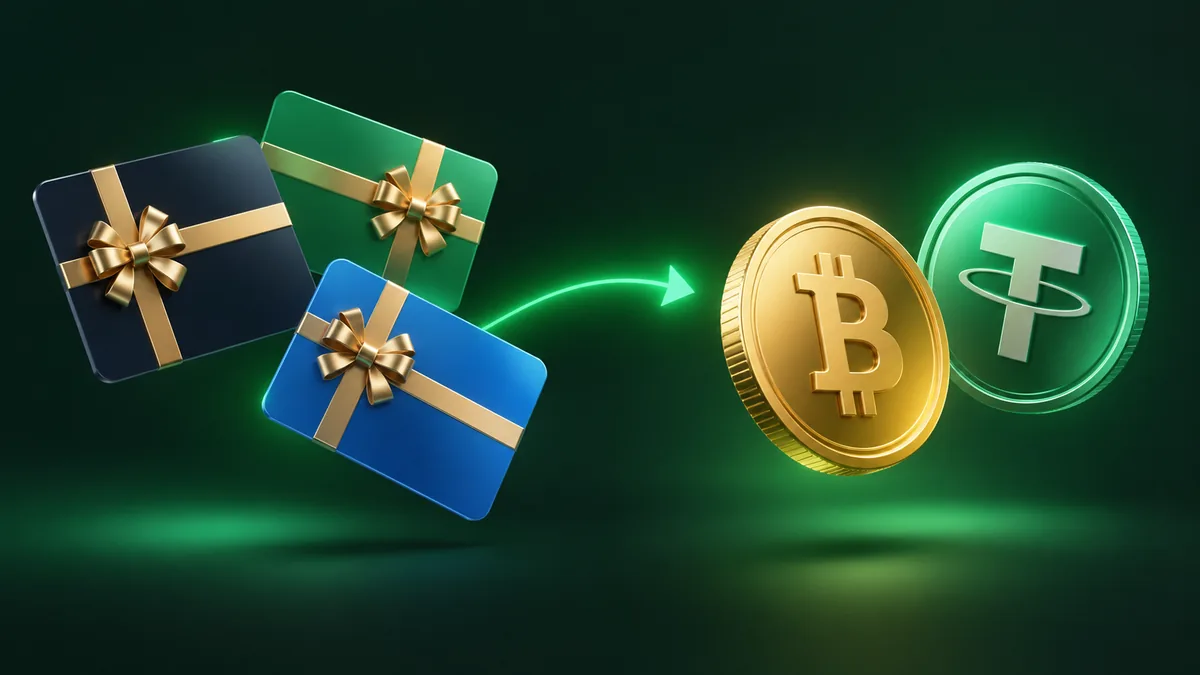
Unused Gift Cards: Five Ways to Redeem Value
Unwanted gift cards often sit forgotten in drawers or digital inboxes simply because the recipient does not shop at the issuing store. Instead of letting that purchasing power expire or sit idle, cardholders can liquidate their balances through regifting, personal swaps, online marketplaces, spend-down strategies, or direct conversion into cryptocurrency. Each approach carries distinct trade-offs between speed, payout rates, and counterparty safety.
Why millions in gift cards remain unspent
Prepaid cards and vouchers are popular gifts because they are convenient to purchase, but that convenience rarely accounts for personal preferences. A gamer who plays exclusively on a PC has little use for a console store credit, and someone who receives a closed-loop merchant card might live miles away from the nearest branch. Because closed-loop cards restrict spending to one specific merchant or platform, any mismatch between the giver and recipient results in stagnant value.
Retail vouchers also come with frictions that lead to dormancy. Digital codes get buried under inbox clutter, physical cards lose their magnetic strip functionality, and partial balances get abandoned once the remaining sum falls below the price of an item. Without an intentional exit plan, unused balances steadily accumulate until they are lost or absorbed by inactivity terms where permitted by law.
Option 1: Regifting or trade with friends
The simplest way to recover value from an unwanted voucher is passing it along to an acquaintance who already shops at that retailer. This can happen through two primary paths: straightforward regifting or an informal trade.
Passing the card along
Regifting a completely untouched retail voucher or gaming code to a friend, colleague, or family member during holidays or birthdays preserves the full face value. It avoids processing fees, transaction friction, and verification steps entirely. To regift properly, verify the balance first without redeeming the underlying claim code to your own profile, and ensure any physical protective scratch-off coating remains intact.
Informal peer swaps
If you prefer an immediate return, propose a trade within your personal circle. Gamers regularly trade titles or digital store codes with friends in exchange for a different platform voucher, a shared dinner, or standard peer-to-peer transfers. Because you deal with people you know personally, the risk of chargebacks or fraudulent dispute claims is minimal, though the pool of interested trading partners is naturally limited.
Option 2: Listing on secondary peer marketplaces
When your immediate circle has no interest in the store credit, online peer marketplaces offer broader exposure. These platforms let users list retail codes and physical cards for sale to secondary buyers at a discounted rate.
Marketplaces typically function through an escrow model. You list your voucher, a buyer accepts the offer, the platform holds the buyer's funds, and once the buyer confirms that the card balance is intact and functional, the platform releases the balance to you minus a platform service fee.
While this method gives you access to a global buyer pool, it introduces several trade-offs:
- Payment delays: Payouts rarely happen instantly. Buyers are usually granted an inspection window ranging from several hours to several days to verify and spend the balance before funds are released.
- Buyer disputes: Dishonest buyers may claim a voucher was already depleted or blocked upon receipt, forcing you into dispute resolution where proving the code was active at delivery can be difficult.
- Platform withdrawal fees: Cashing out your balance from the marketplace balance to your bank account or payment processor often incurs secondary transfer deductions.
Option 3: Converting directly to cryptocurrency
For cardholders looking to avoid personal disputes and protracted listing periods, direct voucher-to-crypto exchanges provide a systematic alternative. Rather than negotiating with retail buyers, you exchange supported vouchers directly with a dedicated conversion platform that processes the balance and sends digital assets straight to your private non-custodial wallet.
At PayPuu, we have provided this direct route since 2020. Our service focuses exclusively on converting supported gaming and prepaid cards into crypto; we do not buy crypto from users, sell gift cards, or issue fiat cash transfers. You can review current pair valuations and supported card types on our live rates page before initiating an order.
Checklist before submitting a card
Before submitting any digital code or retail voucher for liquidation, running a quick verification check prevents cancelled orders and delays:
- Confirm platform compatibility: Check that the issuer and region match. For instance, we accept specific denominations such as Steam (USD, EUR), Xbox (USD, EUR, GBP), PlayStation (USD), paysafecard (EUR), NeoSurf (EUR, GBP), and Razer Gold (USD).
- Verify the exact balance: Ensure the card has not been partially redeemed, blocked by the merchant, or left unactivated at the register. Orders submitted with invalid, depleted, or inactive codes are cancelled without payout.
- Match your address and network: Cryptocurrency transfers cannot be reversed. If you request a payout in USDT over TRON, ensure your destination address is a valid TRC20 address. Similarly, native coins like Solana (SOL), Bitcoin (BTC), or Litecoin (LTC) require their respective native chain addresses.
How direct exchange works
- Select your card brand, regional currency, and payout asset on our exchange widget. Enter your card balance to see the exact cryptocurrency and USD-equivalent sum you will receive. The rate includes our service fee, and the coin's network fee is clearly shown before you confirm.
- Provide your receiving wallet address and an email address. Guest checkout is standard; an internal tracking profile is automatically generated to help you monitor progress.
- Enter your voucher details on the secure order page.
- Our team manually verifies the voucher balance, a process that typically takes 20 to 30 minutes, though peak traffic periods may take slightly longer.
- Once verified, your digital assets are released directly on-chain to your specified wallet address.
Comparing convenience, speed, and safety
Choosing the best liquidation method depends on how quickly you need liquidity and how much effort you are willing to spend managing the process.
Regifting delivers complete face-value retention without digital transaction risks, but it does not return liquid cash or assets to your own pocket. Informal swaps among friends eliminate fraud risks, yet finding an acquaintance who needs your exact retail brand can take weeks.
Secondary peer marketplaces offer the highest theoretical cash return if you find a buyer willing to purchase close to face value, but they demand active listing management, patience through clearing windows, and exposure to buyer redemption disputes.
Direct crypto liquidation trades a margin of the nominal card balance for automated finality. Because our team verifies vouchers directly without peer intermediaries, completed orders settle to your wallet without chargeback risks or payment reversal delays. If you encounter questions regarding minimum transaction requirements or order steps, our help center covers regional requirements and order tracking instructions.
FAQ
What happens if my gift card code fails verification?
If a voucher code is invalid, unactivated, already redeemed, or region-locked, the order is cancelled. The order status page updates with the specific reason for the cancellation, and no payout is issued.
How long does manual voucher processing take?
Most submissions are verified and released by our team within 20 to 30 minutes. Turnaround times can occasionally extend during high-volume periods or when issuers experience verification server delays.
Are cryptocurrency payouts from gift cards reversible?
No. Once a voucher is verified and the transaction is confirmed on the blockchain, the transfer is permanent. You must verify that your wallet address matches the specific coin and network selected on the order form.